November 9, 2026
Where does AI rollout risk belong in your risk register?

AI data security causing headaches? Before you log “employees sharing data with AI” as a people problem, check who handed them the AI in the first place.

People who don’t report a phish have their reasons. So do people who click one. In any human risk management (HRM) platform, it’s easy to see that, say, someone in your finance team clicked a phishing email. The reports are full of counts, stats and activity logs that tell you so in any number of ways. What you don’t know, and can’t know from the event alone, is why. Until you know why, you can’t target the right intervention.
Two people can do the same thing for very different reasons. Ask three people who clicked the same email and you might hear three reasons, each needing a different fix:
A click on a phishing link
Your logs see the same thing three times.
FixLearning: how to check a link
FixA practical way to check links on mobile
FixA nudge at the moment of action
Our mission is to end the guesswork in human security. The biggest guess left is why people do what they do. So we built Behaviour surveys to ask them.
Every reason is mapped to a recognised behavioural science model, so you can see which kind of intervention each person needs.
We built Behaviour surveys with Prof Jason Nurse from our Science & Research team. Jason is lead author of the paper that introduced a behavioural ontology for cybersecurity, built on SebDB, the open Security Behaviours Database. It sets out how the parts of behaviour change connect:
Simplified from the behavioural intervention domain of the SebDB ontology (Nurse, Dobrontei, Webster and Alashe, HCII 2026).
It’s natural to read this left to right, following the arrows. However, you can’t choose the right technique until you know the determinant, the real reason behind the behaviour. The ontology describes determinants using the COM-B model, which is widely used in behavioural science. In COM-B, a behaviour only happens when someone has the Capability, the Opportunity and the Motivation to do it, and each of those splits in two:
Going back to our initial example of the three clicks. Each reason falls into one of these categories:
That categorisation is the link between the reason and the intervention you need to change their behaviour. Learning closes a capability gap, a practical change creates the opportunity, and a nudge interrupts autopilot.
You hear from the people involved while the details are still fresh in their minds, so their answers point to the real reason.
The most common way of understanding how people feel about security in general is via annual culture surveys. They are useful, but by the time they’re asked, the moments people could tell you about have long since passed. Instead, you get the broad trends rather than specific detail.
We built Behaviour surveys to start from the moment the behaviour is detected. When something risky happens (a click on a phishing link, a simulation nobody reported, restricted data sent outside the business), the survey goes to the person involved. This is configurable, so you can send it as soon as possible whilst the event is fresh in their mind, or give them a few days so it doesn’t look like you’ve got them under a microscope.
Importantly, the survey shows the exact situation: the date, the subject line, the person the email went to. So, whatever delay you choose, nobody has to cast their mind back to “that time you might have done something”. It’s a direct link.
Tone matters as much as timing. If people feel blamed, they give defensive answers, and a defensive answer points you at the wrong barrier. A survey intro might look like this:
 Microsoft Teams
CybSafe
On 3 November 2026 at 09:42, an email you received titled Your parcel couldn’t be delivered contained a harmful link that it looks like was clicked. Things like this happen from time to time and we’ve already dealt with it. We’d love to understand a bit more about your experience of that message, so we can make things better for you and the team.
You choose how to ask, from a quick checklist to an open question, to suit your people.
Writing questions is a balancing act. We want scientific rigour, and we know every organisation is different. So one set of questions would never be enough. For each behaviour, we provide question sets in three styles, and you pick the one that suits your people best. Here are some examples:
Pick every reason that applies. Each option points to a barrier.
What do you think played a role? Select any that apply.
One choice, then a follow-up written for that answer.
Before you clicked, which best describes what happened?
Follow-upWhat did you look at, and what made the link seem like it was safe to click?
One question, answered in the person’s own words.
Thinking back to that message, what was your experience of it and what led you to click the link?
Question wording from the live question sets.
Each style balances structure and depth differently. A checklist gives clean answers you can compare across people, and they map straight to COM-B. However, you only hear the reasons you thought to list. An open question can surface the reasons you didn’t think of. Guided sits in between, with one choice and a free-text follow-up.
The variation also shows us how people actually respond in these situations. Over time, we’ll use that data to suggest which style will give you the most insight in your organisation.
Every style gives people a way to say “I don’t really remember this one”. If you don’t ask in the moment, people sometimes won’t remember the event you’re referring to. This option stops them guessing and keeps the data focused on real reasons, so you get to root causes faster, with less noise.
Surveys land in Microsoft Teams or Slack, where answering is quick and easy, so you get more useful data.
A message with a link to a survey is easy to ignore or put off. By the time you get round to it, you’ve forgotten what happened. Behaviour surveys can go straight into your people’s chat apps, like Microsoft Teams or Slack, as interactive messages, so people can pick options, tick boxes or write free text without leaving their flow, then get back to work.
Everyone is busy. Removing barriers makes answering easy, and that makes the data more useful. So you get to the root causes of risky behaviour faster.
Microsoft TeamsCybSafe
On 23rd November 2026, our security system flagged that Archive.zip sent to hello@acme.org may have contained restricted information. These checks sometimes flag things that turned out to be fine, but either way we’d love to understand a bit more about what happened.
Sam Turner
I didn’t realise hello@acme.org wasn’t supposed to receive it
Aisha Khan
I thought it was probably fine to share, or had a reason to go ahead
CybSafe
That’s really helpful to know. What was it about the situation that made sharing it feel like the right call at the time?
Free-text answers are sorted by barrier for you, so you don’t have to read through them one by one.
Checklist answers map straight to COM-B, but what about free-text responses? Pulling meaning out of text is something large language models (LLMs) are exceptionally good at. We’ve built that capability into the CybSafe Signal ecosystem to map answers onto the COM-B framework. You don’t have to sort through thousands of answers to work out the mappings yourself. For organisations that would rather not have an LLM handle their data, we’ve also fine-tuned our own model in-house, built on a variant from the BERT family.
Both proved very accurate in our evaluations, so you can trust the results. Because you’re looking for common themes to address, a little noise won’t change those, and the time you save is definitely well worth it!
You get the key findings in plain language first, with every figure calculated by a statistical engine, not by AI.
As if we haven’t talked about enough cool stuff, Behaviour surveys also come with our first AI-native report. The written findings are the first thing you see when the page opens. Rather than working out your own analysis from the graphs and tables, you get them as backup for the findings (or to double-check if you really want!).
LLMs have come a long way, but it’s fair to be cautious about them, especially with something as important as a report you’ll act on, with a direct effect on your people. You need to trust what it says. So we only use AI as a presentation layer, to show the findings in a way that’s easy to take in. The AI doesn’t do the analysis. We do that in a rigorous, deterministic way, with guardrails that stop the AI from ever changing the figures it presents.
Behind the scenes, a statistical engine builds up metrics in several ways:
Cutting the data in many ways like this lets us find cohorts of people who share the same barriers. Group averages can’t do that, because they lose the nuance of the different people in your organisation.
You get a recommended next step for each barrier, so you’re not left working out what to do with the findings.
Reporting often stops at the analysis: here’s a common barrier, now it’s on you to sort it out. That’s not good enough for a platform grounded in science. We’ve done the analysis, so it would be criminal not to go one step further and recommend what to do.
One of the most common ways to influence behaviour is to nudge people when a risky behaviour happens. The analysis tells you who to aim it at, but we can go further and narrow our nudge library down to the nudges that best target the barrier we’ve identified.
In the platform, nudges map to five mechanisms: Compare, Risk, Facilitate, Emotion and Social. Each COM-B barrier has a primary mechanism that addresses it best, often with a range of supporting ones. So choosing a nudge is one less thing to worry about.
| Barrier | Compare | Risk | Facilitate | Emotion | Social |
|---|---|---|---|---|---|
| Psychological capability | |||||
| Physical capability | Never nudged | ||||
| Physical opportunity | |||||
| Social opportunity | |||||
| Reflective motivation | |||||
| Automatic motivation | |||||
A starting point, not an allow list: every mechanism stays available.
Physical capability is never nudged. If someone can’t do something, sending them a message won’t change that. It needs learning or a practical fix instead.
A recommendation might be a nudge from our library, a learning module, a new nudge or module written with CybSafe Signal, or an off-platform action from a catalogue we’ve curated.
Soon you’ll be able to test each recommendation and see whether it changed behaviour.
A recommendation is a well-informed starting point, but every organisation is different, so you’ll want to know it worked. So every recommendation will be able to run as a Behaviour intervention on the platform. That’s where the guesswork stops.
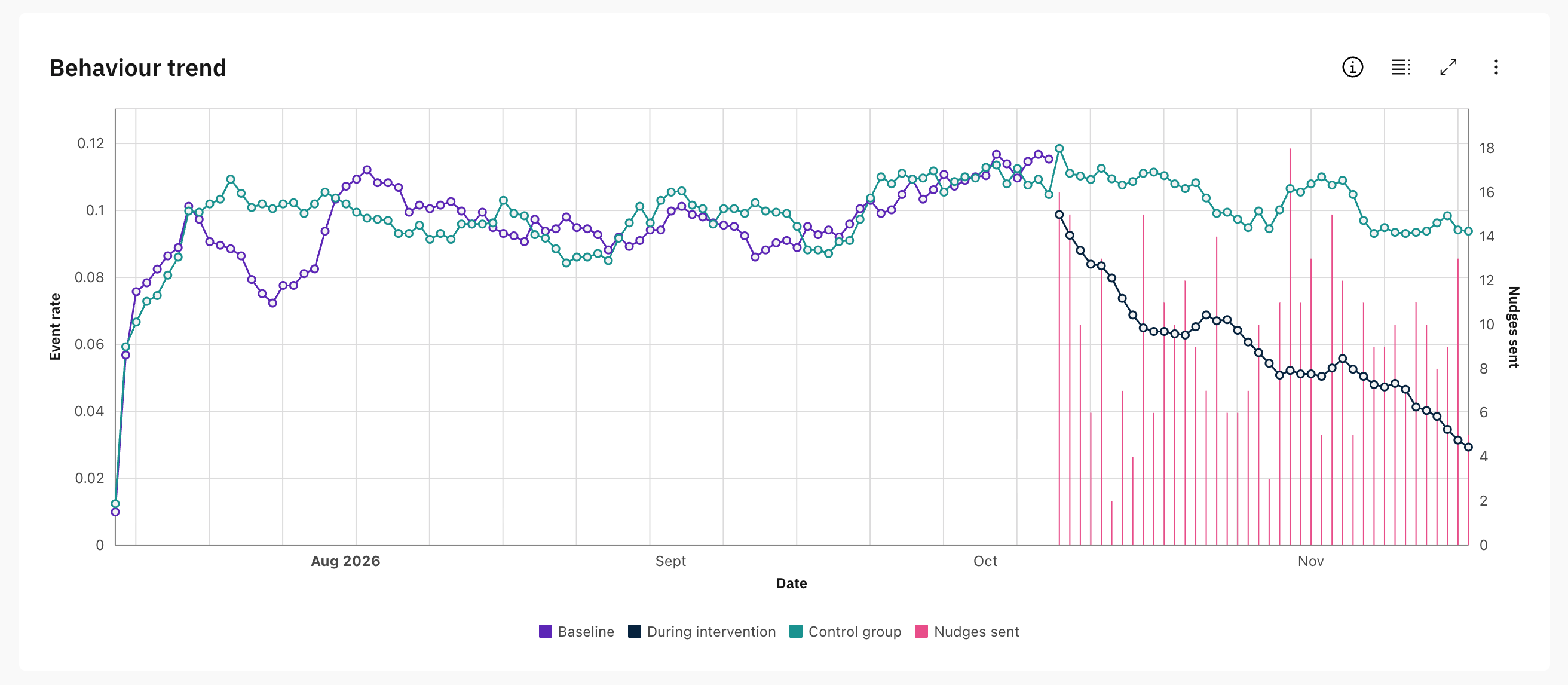
A Behaviour intervention targets an action at a specific audience for a single security behaviour, which is exactly what our recommendations look like. Say you send a nudge whenever a risky behaviour happens. You’ll be able to track the nudges sent and how the behaviour’s event rate changes in response. External factors often play a part too, so you’ll be able to hold out a control group and know your intervention caused the change.
No doubt these should be a post all to themselves, so I’ll just tease them here. As the saying goes, a picture tells a thousand words: