November 9, 2026
Where does AI rollout risk belong in your risk register?

AI data security causing headaches? Before you log “employees sharing data with AI” as a people problem, check who handed them the AI in the first place.


AI data security causing headaches? Before you log “employees sharing data with AI” as a people problem, check who handed them the AI in the first place.
When someone pastes sensitive information into an AI tool, the reflex is to file it under misconduct. Policy breached, person at fault, fix is a reminder (or, heaven help us, more training).
The Oh, Behave! 2026/27 data points to a different reading. The report finds that AI adoption has outpaced AI governance, and this risk sits squarely in that gap. That changes where it belongs in your risk register, as well as what will actually reduce it.
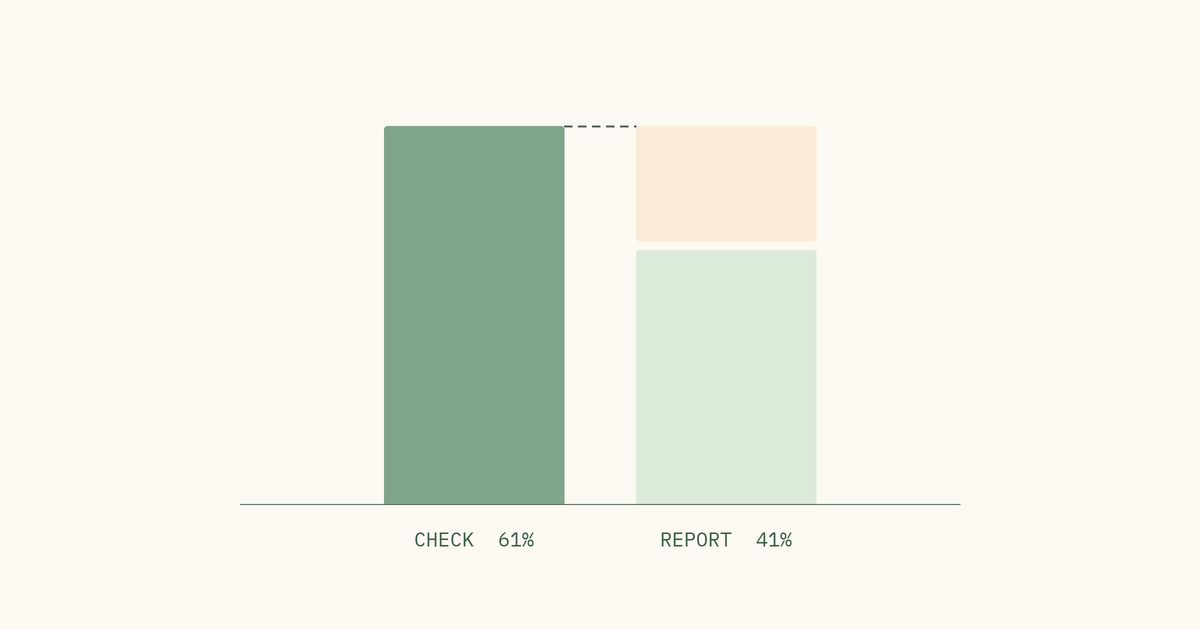
We surveyed 5,000 adults across the UK, US, India, Brazil and Singapore this year. Half of all respondents use AI at work. Of those, 41% started doing so on their own initiative, while 44% started because their employer required or encouraged it. In the UK, 49% were encouraged by their employer.
So basically, someone opened the front door and asked people to walk through it. Fair enough, but that comes with a job attached.
52% of working AI users have had no AI security or privacy training. 24% say their employer never explained what it’s OK to share and 19% say it was unclear.
The message people received was “use this”. Far fewer received the message “and here's what not to put in it”.
Across the five countries, 32% of people who use AI at work have shared sensitive company information with it without their employer knowing. Of those who shared, 50% said internal documents or customer data and 47% said financial data.
Put that next to the numbers above and a pattern appears: people were asked to use AI, but weren't shown where the boundaries were. So, without clear guidance, people had to draw the line themselves. And when nobody hands out the ruler, that line comes out a little wobbly.
How you frame a risk decides how you treat it.
When it’s logged as people misbehaving, the treatment is discipline and reminders, and the root cause stays exactly where it was. Whereas when it’s logged as a gap in how the organisation managed a change, the treatment is a control the organisation owns (and – importantly – can put in front of an auditor).
A register entry might look like this:
This framing is also easier to take to the business, because it doesn't accuse anyone. It says the organisation changed how work gets done and needs to finish the job. Most leaders can live with that.
The report's recommendation is simple: go beyond policy acknowledgement and give people concrete examples of what's OK to share and what isn't.
A signed policy proves someone saw a document. It doesn't prove they can tell whether a customer email, a draft contract or a spreadsheet of sales figures can go into a prompt. (Ask three people in your organisation …we'll wait.)
Concrete examples close that gap. In practice, that means:
Whatever framework you map to – whether that's ISO 27001, DORA, NIS2 or your own internal version – the questions tend to be the same. Is the risk identified and owned? Is there a control? Can you show it works?
Here’s the evidence that answers them:
Training completion still has a place, but as an input. On its own, it shows people sat through something, but it doesn't show that the risk went down.
This doesn't need a new programme: the evidence can come from existing reviews and rollout sign-offs. What it does need is one honest register entry, a named owner and a guidance step built into the next AI rollout.
What you get back is a risk you can explain, a control you can evidence and fewer surprises for everyone …including the people who were only doing what they were asked.
Read the full Oh, Behave! 2026/27 report for the complete AI findings, including the UK figures.