.png)
July 1, 2026
These 7 red flags reveal you're stuck in awareness rather than truly managing human risk

Awareness tells people things. HRM and SBM change what they do. These 7 signs show where you're stuck and how to prove real risk reduction.



CybSafe CEO Oz Alashe examines what people mean by “the human side of cybersecurity,” why that matters, and how to surface and shows how to check your blind spots.
After a recent talk I gave, three people came up to chat about the “human side” of cybersecurity.
They all used the same phrase. But each had a different meaning in mind (and nobody was wrong).
Same words, different worlds.
The “human side” (or indeed “human factors”, or “the human aspect” ...the people bit) is useful as a direction, but opaque as shorthand. It’s broad enough to cover almost anything involving people, decisions, or behavior. That’s useful as a signal, but as a shorthand it’s risky as f**k.
“The people bit” is a security discipline in its own right, and is relevant to so many different industries. But we’re in danger of talking past each other …because it’s such a multifaceted kaleidoscope of issues.
And without clarity, we end up misaligned, we argue while agreeing, and we leave blind spots.
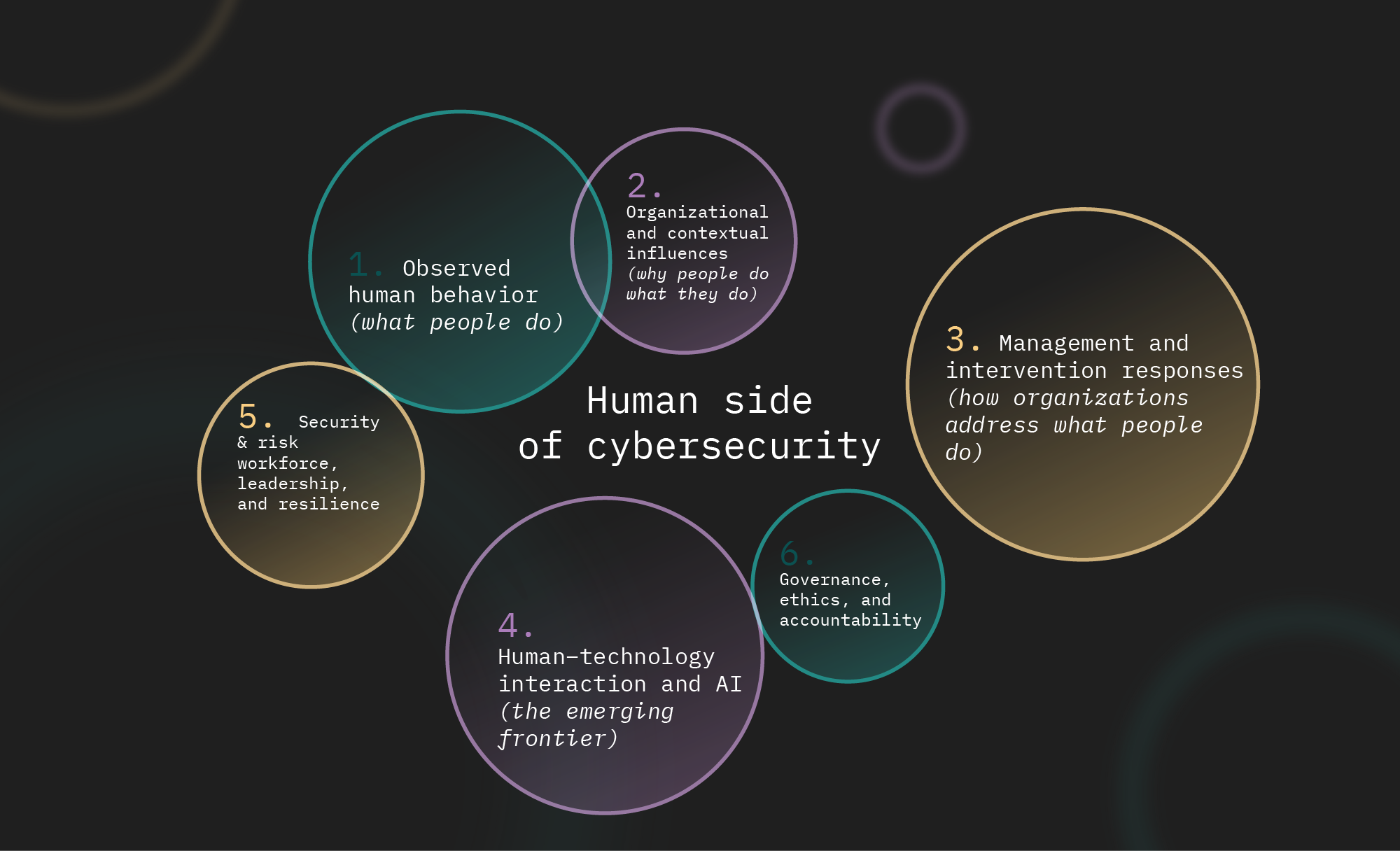
To cut the cross-talk, I’ve mapped the six domains of the “human side”. I’m sharing it here because I think it’ll help. (It might even shave time off your meetings, but no promises.)
This part is where I break the human side into six domains. Please know that this isn’t a hierarchy, nor is it a maturity model, and the edges overlap. Each domain is valid on its own, and together they give you the fuller picture.
I want to give you clarity so you can say which one you mean, see where it overlaps with others, and spot the blind spots before they become regrets.
This is the visible stuff. The clicks, choices, and habits that move risk up or down in the real world. CISOs and security leaders reach for this meaning when they want ground truth on real-world behavior and how it tracks to exposure. Practitioners and program leads use it to keep conversations anchored in evidence and trend lines. It’s the language of “did the behavior move, and by how much?”
This looks like:
It’s also technical behavior like:
Why it matters: Outcomes live here. What people do is what you get.
No one makes choices in a vacuum. People respond to the environment they’re in. CISOs, HR, engineering leadership, and UX leaders use this focus to align culture, incentives, workload, and tooling with risk objectives. It frames the human side as conditions and constraints that shape outcomes at scale. The conversation is about operating norms and making the secure path the easy path.
Influences include:
Developer teams feel this in sprint velocity, tooling, and the clarity of security requirements. Operations teams feel it in alert fatigue and the weight of on-call. And *everyone* feels it when the secure path takes ten clicks and the risky path takes two.
Why it matters: If you want different outcomes, change the conditions, not just the slogans.
This is how we try to influence and manage human-related risk. This is the operating-model view. CISOs, GRC, and program owners use it to talk about mechanisms, measurement, and accountability: what gets deployed, how it’s tested, and how it’s sustained. Platform and automation teams join here to turn good practices into repeatable systems.
That might look like:
Why it matters: You need systems that turn intent into repeatable outcomes, not one-off heroics.
Here the human side meets automation and intelligent systems. CISOs, CTOs, architects, and AI governance groups may use this focus to place human decision-making alongside automated and intelligent systems. It’s about roles, boundaries, oversight, and human-in-the-loop expectations. The focus is on a reliable handshake between people and machines.
That looks like:
Why it matters: The surface area is growing, fast, and the human+AI handshake is now a security domain of its own.
This is the human side as it applies to the people doing the work. CISOs and people leaders use this when talking about reading the human side through the teams doing the work. Capacity, capability, leadership pipeline, and team health sit at the center. Collaboration with IT and engineering shows up here as a core part of sustained performance.
It looks something like this:
Why it matters: Healthy, capable teams make better security decisions, consistently.
This is the leadership layer. Boards, executives, legal, privacy, audit, and the CISO converge on this angle to define ownership and trust. It’s where responsibility is assigned, guardrails are set, and transparency is agreed. The conversation is about aligning human-risk oversight with strategy and values.
The focus here is on:
Why it matters: Trust is an outcome, too. If people don’t trust the system, they route around it.
Each domain is legitimate. But if we don’t say which one we mean, we get crossed wires.
One team says “the human side” and wants to talk about daily behavior. Another hears the same phrase and starts discussing leadership, incentives, and culture. A third heads straight to AI oversight. Everyone is correct, no one is aligned.
The result might sound familiar to you: ambitious goals, fuzzy scope, patchy ownership, and reports that count activity while missing outcomes. It’s not bad intent. It’s fuzzy language.
The fix is effective and, I’ll admit, a little boring:
Define terms at the start and keep the map in view.
Then whoever you’re in discussion with knows exactly where you’re coming from. In your next meeting, name your focus.
You don’t need to cover all six domains to do great work. You do need to know which ones you’re addressing and how they relate.
If you’re focused on observed behavior, say so. Measure the behaviors that move risk.
If you’re shaping context and conditions, say so. Show how incentives and friction change outcomes.
If you’re building management responses, say so. Prove what works and automate it.
And if you’re working in the other three domains (that is, AI interaction, workforce and leadership, governance and ethics), call that out.
For us, most of our effort lives in the first three domains:
1. Observed human behavior, because outcomes depend on what people actually do.
2. Organizational and contextual influences, because capability, motivation, and opportunity shape those choices.
3. Management and intervention responses, because you need systems that identify risky patterns, test what changes them, and automate what works at scale.
That’s where we spend our time understanding real behavior, influencing it with evidence, and turning good interventions into repeatable workflows. And, as you now know, it’s not the whole human side of cybersecurity, but it’s a critical part of it, and it connects into the others rather than replacing them.
Now you have the map, you can:
Work on clarity first, then progress and scaling will follow more easily.
We’ve written the Ultimate HRM guide for a deeper dive on human risk. It covers what human risk management is, how it actually works, the behaviors that drive risk, the metrics leaders care about, and the first steps to put it to work.
For more thinking like this blog, the Behave Hub is a good place to hang out.
And remember, I’m with you on this journey, one clear definition and one real outcome at a time.

%20copy.png)